SAASS 667

SAASS 667 Comps Study Wall

Cover-first for fast recall, with each book distilled into three main ideas and compact connection notes.

Total Cold War

Eisenhower's Secret Propaganda Battle at Home and Abroad

Kenneth Osgood

3 main ideas

  • Eisenhower made psychological warfare a central instrument of U.S. grand strategy rather than a supporting afterthought.
  • U.S. propaganda worked through a state-private network that fused overt messaging, covert action, and symbolic policy initiatives.
  • The Cold War’s “total” character collapsed foreign and domestic audiences into one battlespace, forcing Washington to manage legitimacy at home and abroad.

Themes

grand strategynarrative competitioninformation warfare

Connected books

  • Subversion Extends

    Networked narrative warfare updates Osgood’s propaganda logic for the digital age.

  • Spin Dictators Shares framework

    Both show rulers manufacturing consent by managing information.

  • World War II Memory and Contested Commemorations in Europe and Russia Supports

    Both show political actors curating symbols and history to legitimize present policy.

  • New Cold Wars Similar case, different conclusion

    Both analyze systemic rivalry, but Sanger’s contest is structured more by technology and interdependence than by bipolar ideology alone.
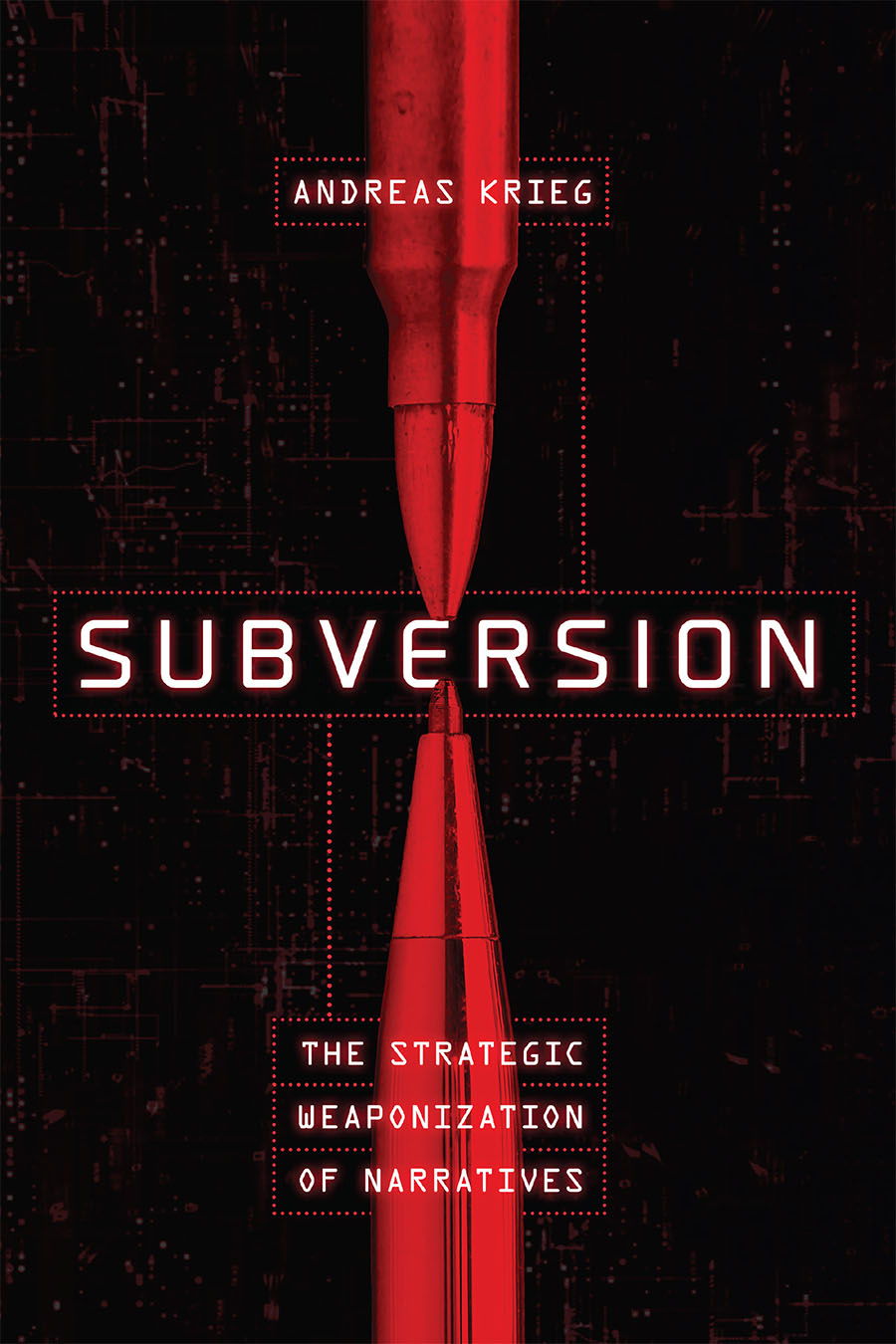
Subversion

The Strategic Weaponization of Narratives

Andreas Krieg

3 main ideas

  • Subversion weaponizes narratives to erode a target society’s internal cohesion below the threshold of war.
  • Narrative campaigns achieve strategic effects by exploiting preexisting grievances, identities, and institutional mistrust rather than by direct force.
  • Strategic effects emerge when actors orchestrate narratives across media and political networks to alter how audiences interpret events, legitimacy, and action.

Themes

narrative competitioninformation warfarelegitimacy

Connected books

  • Total Cold War Extends

    Updates Cold War propaganda into networked narrative warfare.

  • Spin Dictators Supports

    Shows how modern autocrats operationalize narrative manipulation to sustain rule.

  • World War II Memory and Contested Commemorations in Europe and Russia Shares framework

    Both analyze actors weaponizing public meaning to alter legitimacy and identity.

  • How Data Happened Supports

    Shows the infrastructures that scale narrative targeting.

How Data Happened

A History from the Age of Reason to the Age of Algorithms

Chris Wiggins · Matthew L. Jones

3 main ideas

  • Data systems are political constructions that classify people and problems according to institutional choices, not neutral facts.
  • States, militaries, and firms built data infrastructures that redistributed authority by determining what could be measured, compared, governed, and automated.
  • The move from statistics to algorithms shifted decision authority toward opaque technical systems and the organizations that own them.

Themes

digital governancepolitical economydecision-making

Connected books

  • Digital Empires Extends

    Turns the history of data institutions into a geopolitical struggle over regulating digital markets.

  • Subversion Supports

    Shows how data-rich platforms make targeted influence operations possible at scale.

  • Age of Deception Shares framework

    Both reject technological determinism and foreground institutions in digital power.

  • This Is How They Tell Me the World Ends Supports

    Shows that dense software dependence creates common points of failure and exploitation.

3 main ideas

  • States and political entrepreneurs actively contest World War II memory because control over the past redistributes legitimacy in the present.
  • Commemorations, monuments, and education stabilize preferred narratives by assigning societies the roles of hero, victim, or perpetrator.
  • Memory challengers use grievance and historical equivalence to revise dominant narratives for domestic mobilization and interstate advantage.

Themes

narrative competitionlegitimacyideational change

Connected books

  • Subversion Shares framework

    Both show political actors reshaping collective meaning to alter present legitimacy.

  • Spin Dictators Supports

    Curated history reinforces contemporary authoritarian legitimacy.

  • New Cold Wars Extends

    Russian memory politics feeds current geopolitical confrontation.

Spin Dictators

The Changing Face of Tyranny in the 21st Century

Sergei Guriev · Daniel Treisman

3 main ideas

  • Modern autocrats survive by manufacturing popularity and plausible competence more often than by relying on mass terror alone.
  • Controlled media, selective censorship, and electoral theater protect regime legitimacy while hiding coercion in the background.
  • Globalization and digital communications let rulers substitute managed perceptions and selective repression for mass terror while preserving authoritarian control.

Themes

narrative competitionlegitimacyperception

Connected books

  • Subversion Supports

    Narrative weaponization is a core mechanism of modern authoritarian rule.

  • Digital Empires Extends

    Platform governance and digital infrastructure shape the tools available to spin dictators.

  • How Data Happened Supports

    Data collection and platform mediation furnish the instruments with which modern autocrats manufacture consent.

  • World War II Memory and Contested Commemorations in Europe and Russia Supports

    Curated historical narratives strengthen regime legitimacy.

Offensive Cyber Operations

Understanding Intangible Warfare

Daniel Moore

3 main ideas

  • Offensive cyber operations belong to a broader tradition of intangible warfare rather than constituting a wholly autonomous revolution in war.
  • Presence-based operations and event-based operations have distinct operational logics, effects, and command implications.
  • Cyber operations create the most value when integrated with broader campaigns because they rarely deliver decisive strategic outcomes on their own.

Themes

cyber powerstrategyjoint warfare

Connected books

  • Age of Deception Shares framework

    Both reject effortless digital offense and tie outcomes to organization, access, and intelligence.

  • Escalation Dynamics in Cyberspace Supports

    If cyber effects are limited and hard to sustain, escalation pressure usually remains bounded.

  • Cyber Persistence Theory Similar case, different conclusion

    Moore assigns cyber a narrower supporting role than CPT does.

  • This Is How They Tell Me the World Ends Extends

    Perlroth explains the exploit market that supplies the tools Moore categorizes.

Age of Deception

Cybersecurity as Secret Statecraft

Jon R. Lindsay

3 main ideas

  • Cybersecurity is a problem of secret statecraft in which actors exploit cooperative institutions for intelligence advantage.
  • Intelligence performance turns on the interaction between vulnerable institutions and clandestine organizations that can create and preserve secret channels to valuable targets.
  • The same institutional complexity that enables cyber exploitation degrades control and limits the independent coercive value of cyber operations.

Themes

intelligence contestcyber powerinstitutions

Connected books

  • Offensive Cyber Operations Shares framework

    Both tie cyber effectiveness to organization, access, and campaign integration rather than to hype about offense.

  • Cyber Persistence Theory Similar case, different conclusion

    Both center exploitation and access, but Lindsay treats cyber as secret statecraft constrained by complexity whereas CPT treats persistent campaigning as a route to cumulative strategic gain.

  • Escalation Dynamics in Cyberspace Supports

    Secrecy, intelligence value, and limited control weaken escalation incentives.

  • This Is How They Tell Me the World Ends Extends

    Perlroth traces the market and policy choices that furnish the exploits secret statecraft requires.

Escalation Dynamics in Cyberspace

Erica D. Lonergan · Shawn W. Lonergan

3 main ideas

  • Cyber operations usually dampen escalation because their effects are limited, reversible, and hard to interpret quickly.
  • Secrecy, attribution problems, and intelligence tradeoffs create time and incentives for restraint, weakening pressure for kinetic retaliation.
  • The most dangerous escalation pathway appears when cyber operations threaten nuclear or critical conventional command-and-control systems during wartime.

Themes

cyber powerescalationintelligence contest

Connected books

  • Cyber Persistence Theory Supports

    Both treat below-threshold competition as the normal condition of cyber rivalry.

  • Age of Deception Supports

    Intelligence value and secrecy restrain open escalation.

  • Offensive Cyber Operations Shares framework

    Both assign cyber limited independent coercive power.

  • New Cold Wars Extends

    Ukraine illustrates that cyber matters in war but rarely decides escalation on its own.

This Is How They Tell Me the World Ends

The Cyberweapons Arms Race

Nicole Perlroth

3 main ideas

  • U.S. policy choices helped create and legitimize a global market for zero-day exploits and offensive cyber capability.
  • Once exploits circulate through brokers, contractors, and leaks, offensive tools inevitably proliferate beyond state control.
  • Stockpiling vulnerabilities for intelligence and offense creates systemic defensive blowback because the same weaknesses remain available to adversaries and criminals.

Themes

cyber powerintelligence contestpolitical economy

Connected books

  • Offensive Cyber Operations Extends

    Shows the commercial supply chain behind the offensive techniques Moore describes.

  • Age of Deception Supports

    Demonstrates the material basis of the secret accesses and exploits Lindsay treats as instruments of statecraft.

  • Cyber Persistence Theory Challenges

    Perlroth highlights the defensive blowback of persistent exploitation.

  • Digital Empires Shares framework

    Both show private firms and state policy jointly structuring the strategic environment.

Digital Empires

The Global Battle to Regulate Technology

Anu Bradford

3 main ideas

  • The digital order is structured by competition among American market-driven, Chinese state-driven, and European rights-driven regulatory models that allocate power differently across states, firms, and citizens.
  • Regulation is a geopolitical instrument because control over standards, platform rules, and market access redistributes power across borders.
  • The struggle over technology turns on who governs data, infrastructure, and firms, not only on who invents the best products.

Themes

digital governancepolitical economyinternational order

Connected books

  • How Data Happened Extends

    Turns the history of data institutions into a struggle over who governs digital power.

  • Spin Dictators Supports

    Shows how different regulatory models expand or constrain authoritarian control.

  • This Is How They Tell Me the World Ends Shares framework

    Both show private firms and state policy jointly shaping the strategic terrain of technology competition.

  • New Cold Wars Supports

    Technology ecosystems and economic interdependence are central fronts in contemporary great-power rivalry.

Cyber Persistence Theory

Redefining National Security in Cyberspace

Michael P. Fischerkeller · Emily O. Goldman · Richard J. Harknett

3 main ideas

  • Cyberspace is a strategic environment of continuous contact and exploitation rather than episodic crisis punctuated by rare attacks.
  • States gain advantage through initiative persistence and defend forward because deterrence alone cannot stop exploitation.
  • Security in cyberspace depends on campaigns that impose friction, constrain adversary freedom of action, and build resilience across the broader national ecosystem.

Themes

cyber powerstrategyfriction

Connected books

  • Escalation Dynamics in Cyberspace Supports

    Both see below-threshold competition as the normal condition of cyber rivalry.

  • Age of Deception Shares framework

    Both treat exploitation and access as more central than decisive coercion.

  • Offensive Cyber Operations Similar case, different conclusion

    Moore sees cyber as mainly a supporting military capability, while CPT assigns persistent cyber competition broader strategic utility.

  • This Is How They Tell Me the World Ends Challenges

    Perlroth shows the societal costs of exploit stockpiling that persistent engagement can intensify.

Cover of New Cold Wars

New Cold Wars

China's Rise, Russia's Invasion, and America's Struggle to Defend the West

David E. Sanger · with Mary K. Brooks

3 main ideas

  • The post-Cold War bet that economic interdependence would socialize Russia and China into a stable liberal order failed.
  • Contemporary rivalry turns economic interdependence itself into a field of competition across technology, finance, information, and military pressure.
  • The United States can compete effectively only by combining alliance leadership, economic strategy, and technological resilience while managing escalation risks.

Themes

grand strategyalliance politicspower politics

Connected books

  • Digital Empires Supports

    Regulatory and technological competition is a central front in the new cold wars.

  • This Is How They Tell Me the World Ends Extends

    Cyber insecurity and private-sector vulnerability intensify strategic competition among major powers.

  • Escalation Dynamics in Cyberspace Supports

    Ukraine shows cyber’s utility inside broader war without proving that cyber alone drives escalation.

  • Total Cold War Similar case, different conclusion

    Both analyze systemic rivalry, but Sanger describes a multipolar techno-economic contest rather than a primarily bipolar ideological one.

Recurring themes

Filter the wall by concept.